A-Corps Become Law, and What We’re Learning From Hacienda
Two years in the making, Colorado has just become the first jurisdiction in the world to recognize Artist Corporations (A-Corps) as an official business entity — a groundbreaking legal framework designed to give creators greater control over their work, ownership, and economic future. At the same time, the launch of the Dark Forest Operating System (DFOS) highlights a parallel movement in technology: building digital infrastructure that prioritizes community ownership, creative autonomy, and meaningful collaboration over platform-driven extraction.
Something rare happened in American politics this week: a bipartisan coalition of lawmakers agreed that artists deserve better. Tomorrow, Colorado’s Governor will sign the Colorado Artist Company Act into law — making Colorado the first place in the world to recognize Artist Corporations, or A-Corps, as an official business entity. For those of us who’ve been following this work, it’s a moment worth pausing to appreciate. Meanwhile, ten days out from the launch of Hacienda — the first public release of the Dark Forest Operating System (DFOS) — the team is catching its breath and starting to make sense of what’s working, what’s surprising, and what still needs to be figured out.
The World’s First A-Corp Law
The Colorado Artist Company Act (SB26-133) has been two years in the making. Cosponsored by Senators Bridges (D) and Catlin (R) and Representatives Martinez (D) and Taggart (R), the bill passed through the Colorado legislature with the kind of bipartisan support that feels almost anachronistic right now. The signing ceremony in Denver tomorrow marks the end of a legislative journey — and the beginning of something much larger.
So what actually is an A-Corp?
Think of it as a fork of the LLC model, redesigned from the ground up for the specific realities of creative work. The existing LLC structure works fine if you’re running a restaurant or a software startup. But for artists, the standard structures have always required expensive lawyers to add protections that should be defaults. A-Corps make those protections standard.
A few of the key provisions:
Majority artist control is locked in by law. Artists must own at least 51% of voting power at all times. This isn’t just a clause in an operating agreement that can be negotiated away — it’s written into the statute itself. No investor, no partner, no board can override it.
Every A-Corp has a legally recognized creative mission. The company can declare that its creative purpose takes precedence over financial objectives. An A-Corp can also elect to become a Public Benefit Artist Company if it’s oriented toward broader public good.
IP stays with the people who made it. If an A-Corp dissolves, creative rights revert to their original creators — not to investors, not to the entity. And crucially, when forming an A-Corp, an artist’s IP and labor count as capital contributions to the company’s valuation. That’s a quiet but significant shift in how creative work gets valued from day one.
A new kind of equity. A-Corps can issue fractional ownership shares — “A-shares” — to collaborators, as compensation, or to investors. This opens up a new model of creative economy ownership that doesn’t require signing away control.
No expensive lawyers required. The bill includes fill-in-the-blank formation provisions, making it genuinely accessible. You shouldn’t need a $500/hour attorney to set up a business structure that protects your work. Colorado is a natural home for this. It’s the #1 state in America for the percentage of its population with an active creative practice, with more than 100,000 people employed in creative industries, generating $16.9 billion for the state economy in 2024. There’s a real constituency here, and state leaders recognized it. Because Colorado allows businesses to incorporate from anywhere via registered agents, A-Corps will be accessible to artists well beyond state lines — and the hope is that other states and countries will follow.
Post-Hacienda: What DFOS Is Learning
Ten days ago, Metalabel released Hacienda — the first public version of DFOS, the Dark Forest Operating System. DFOS is software for building private group spaces on the internet: an “OS” with apps, shared group areas, and financial infrastructure built in. It’s a fundamentally different approach to online community, designed for small groups who want to do things together without defaulting to the algorithmic, public-facing dynamics of mainstream platforms. The team has been reflecting on what they’re seeing.
The product is the closest yet to the vision. The OS, the apps, the shared group spaces, money infrastructure — all of it together for the first time. It’s the first public release they feel genuinely proud of.
The biggest recurring question: “What is this? What do we do here?” The team hears this less as criticism and more as a signal: people are pleasantly surprised by how different DFOS feels, but the product needs to do more to orient both Keepers (space operators) and Members (participants) when they arrive. That’s a near-term priority.
Public and private spaces behave very differently. Private channels are where the real energy is — useful, generative, built for doing things together. Public areas can feel like an empty lobby. The team is thinking hard about what it means for a DFOS space to feel “alive” in its public-facing areas.
The dark forest question. Should a DFOS space be able to make its desktop fully public? It’s a genuine tension: openness invites more people in, but the “dark forest” ethos — the idea that staying somewhat in the shadows actually protects creativity — is core to what makes DFOS distinct.
Most spaces have a clear creative focus. Looking across the many spaces that have formed, the pattern is clear: people are using DFOS with intention. That’s a useful north star for how the Discover and network features should eventually be built out. One voice that stuck with the team came from Mark of Tech Itch Recordings and the Sol Invicto space: “Members have supported us through limited releases and understand the value of staying somewhat in the shadows to protect creativity. It’s about quality over quantity — people who appreciate the grandiose, cinematic vision, the imperfections, and the resistance to industry norms.”
Two Projects, One Direction
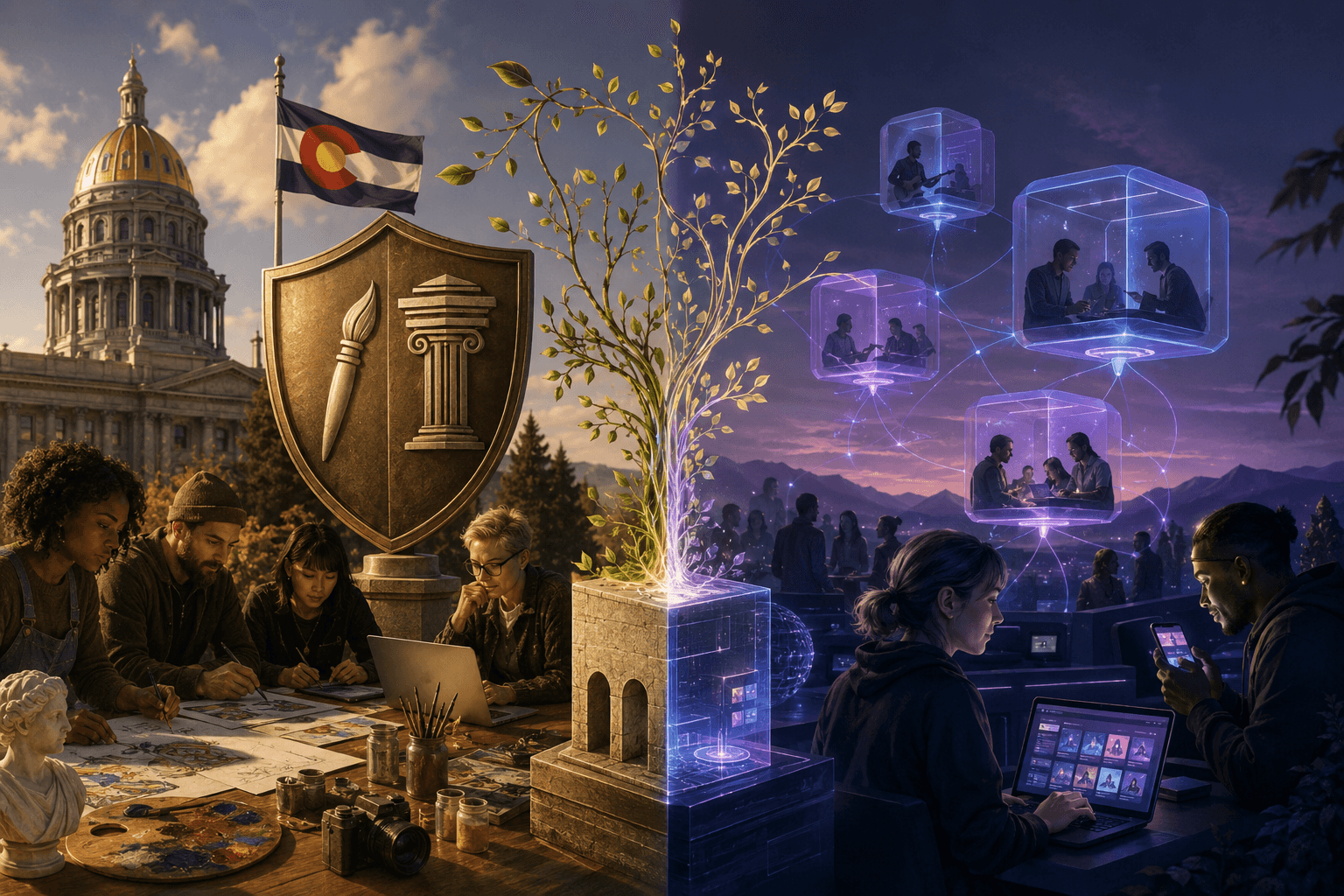
It would be easy to read A-Corps and DFOS as separate initiatives. They’re not. Both are responses to the same underlying problem: the internet and the economy have been structured in ways that systematically extract value from artists and give it to intermediaries, platforms, and investors. A-Corps attack that problem at the legal and economic layer. DFOS attacks it at the infrastructure layer.
Artists don’t need pity. They need power — legal, structural, and technological. This week, they got a little more of each.
Learn More
The first A-Corp law is here — Metalabel Studios
Colorado SB26-133 Colorado General Assembly
Artist Corporations — artistcorporations.com
DFOS R.01: Hacienda — Metalabel Studios
CPR News: First-of-its-kind law to create ‘artist corporations’