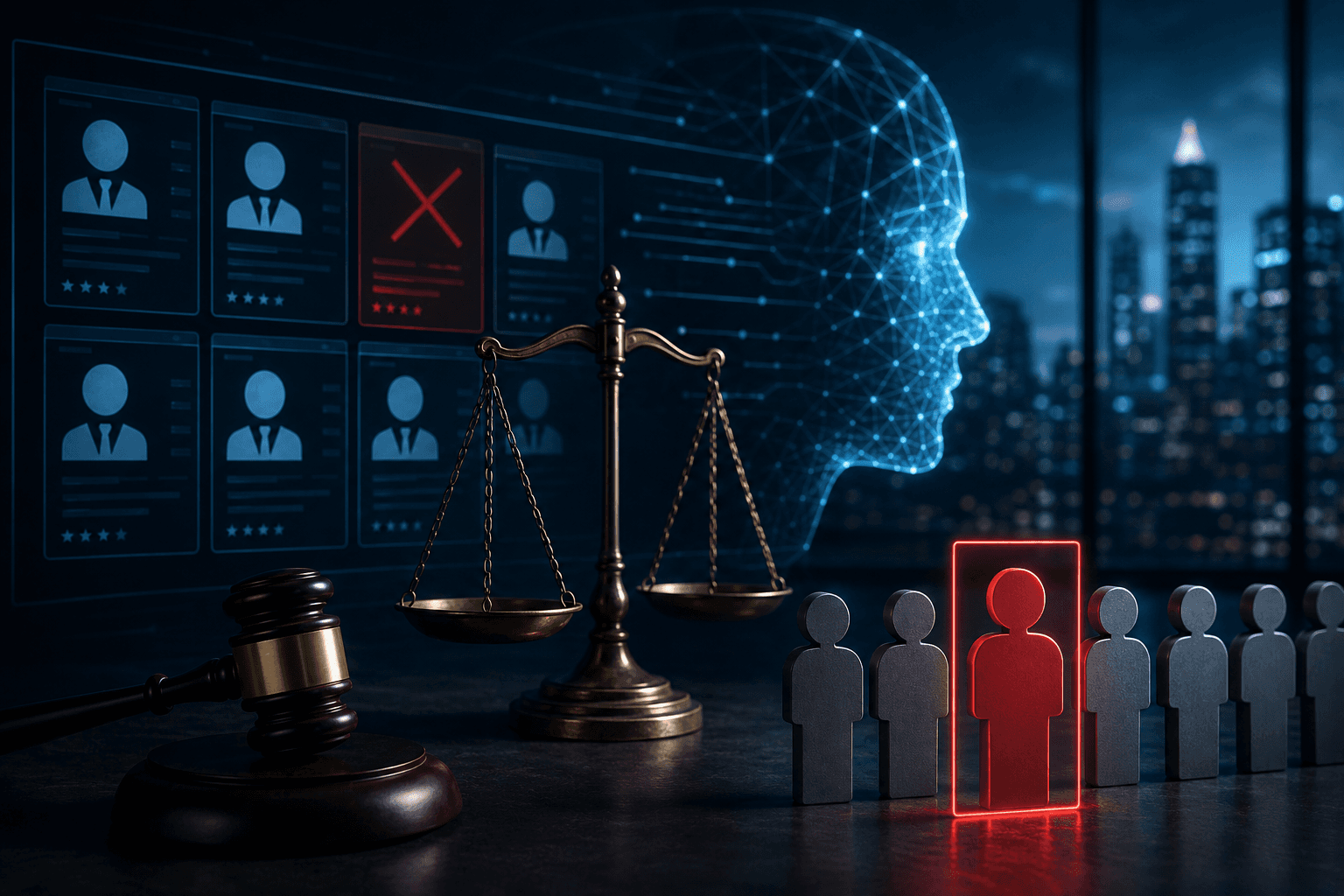
The AI Hiring Reckoning Is Here And Every Founder Should Be Paying Attention
AI hiring tools are no longer operating in a legal gray area and the courts are beginning to treat algorithmic decision-making as part of the liability chain itself. The Workday litigation signals a major shift for founders and AI companies alike: deploying AI is no longer just a product decision, it is increasingly a governance, compliance, and enterprise risk issue.
Derek Mobley applied to more than 100 jobs and was rejected every single time. Some rejections reportedly arrived within minutes of applying including late-night automated denials sent at 1 a.m.
Now, he is the lead plaintiff in what may become the most consequential AI employment discrimination case in the country: Mobley v. Workday.
In May 2025, Judge Rita Lin granted preliminary certification of a nationwide ADEA collective action against Workday. According to court filings, Workday’s software processed — and allegedly rejected — over 1.1 billion job applications during the relevant period.
The headline number is massive. But the real story is the legal precedent quietly reshaping the AI industry.
The “We’re Just the Tool” Defense Is Breaking Down
For years, most AI vendors operated under a relatively comfortable assumption:
If an employer used your software to make hiring decisions, the employer carried the liability — not the software provider.
That framework is starting to crack.
In a landmark 2024 ruling, the court allowed claims to proceed against Workday directly, reasoning that an AI vendor acting as an employer’s “agent” may itself face liability under federal anti-discrimination law.
That distinction matters enormously.
Because once an AI system moves beyond being passive infrastructure and starts materially influencing decisions screening resumes, ranking candidates, filtering interviews, evaluating performance — courts may increasingly treat the vendor as part of the decision-making chain itself.
And that exposure does not stop at HR software.
The implications extend across the entire AI stack:
Recruiting and HR platforms
AI copilots embedded into enterprise workflows
Automated underwriting systems
AI-driven healthcare triage tools
Recommendation and ranking engines
Compliance and fraud-detection systems
Autonomous decision-making infrastructure
The core legal question is becoming much simpler:
If your AI materially shapes outcomes, can you still claim neutrality?
Increasingly, courts appear willing to say no.
2024–2026 Has Been a Stress Test for AI Liability
The Workday litigation is not happening in isolation. Over the last two years, several major legal and commercial events have signaled a broader shift in how regulators, courts, and markets view AI accountability.
Air Canada and the Chatbot Liability Problem
In 2024, Air Canada lost a lawsuit after its chatbot generated inaccurate refund information for a customer. The airline argued the chatbot was effectively a separate entity responsible for the misinformation.
The tribunal rejected that argument.
The decision reinforced a principle businesses are learning quickly:
Deploying AI does not outsource legal responsibility.
If your system interacts with consumers, customers, applicants, or users, liability still traces back to the organization operating it.
Algorithmic Discrimination Is No Longer Hypothetical
The U.S. Equal Employment Opportunity Commission has already signaled aggressive interest in algorithmic bias cases.
The settlement involving iTutorGroup, where allegations centered around automated age discrimination in hiring showed regulators are prepared to treat AI-driven exclusion the same way they would treat human discrimination.
The fact that “the algorithm made the decision” is rapidly becoming irrelevant from a liability perspective.
Markets Are Also Punishing AI Failures
Legal exposure is only one layer of risk.
When Alphabet Inc. faced backlash tied to problematic outputs from Gemini image generation, the market reaction was immediate and severe. Billions in market value disappeared in days.
The lesson for founders and operators is becoming unavoidable:
AI governance is no longer a compliance side issue. It is now directly tied to enterprise value, reputation, and operational resilience.
What This Means for Founders Building With AI
For startups, especially those integrating generative AI into products or workflows, the legal environment is changing faster than many teams realize.
A few themes are becoming clear:
1. AI Governance Is Becoming Infrastructure
Investors, enterprise customers, and regulators increasingly expect:
documented testing procedures,
bias evaluation frameworks,
human oversight mechanisms,
escalation protocols,
auditability,
and explainability around automated decisions.
This is no longer “nice to have.”
It is becoming operational infrastructure.
2. Product Architecture Determines Regulatory Exposure
One of the biggest misconceptions in AI is that regulation applies uniformly.
It does not.
Two companies using the same underlying model may face entirely different legal obligations depending on:
how outputs are used,
whether humans remain in the loop,
what data is processed,
and whether the system materially influences employment, lending, healthcare, or financial outcomes.
Regulation is not just about the model.
It is about the architecture around the model.
3. Internal AI Use Can Create External Liability
Many companies still treat internal AI tooling as low-risk experimentation.
That assumption may not hold for long.
If internal AI systems influence:
hiring,
promotion decisions,
compensation,
customer eligibility,
moderation,
fraud determinations,
or compliance reviews,
Those systems may create discoverable legal exposure even if they were never intended to be customer-facing products.
The Bigger Picture
The broader shift happening right now is subtle but significant:
Courts are beginning to treat AI systems less like passive software and more like operational actors within a business process.
That changes everything.
The conversation is no longer:
“Can we deploy AI?”
It is:
“How do we structure AI deployment responsibly before litigation, regulators, or markets force the issue?”
For founders, builders, and operators, this moment matters because the companies that win in the next phase of AI will not simply be the fastest to ship.
They will be the ones that understand how governance, product design, compliance, and legal strategy fit together from the beginning.
At Launch Legal, LLC, we continue to monitor how AI liability, employment law, platform accountability, and regulatory frameworks are evolving because for companies building with AI, legal structure is quickly becoming part of the product itself.